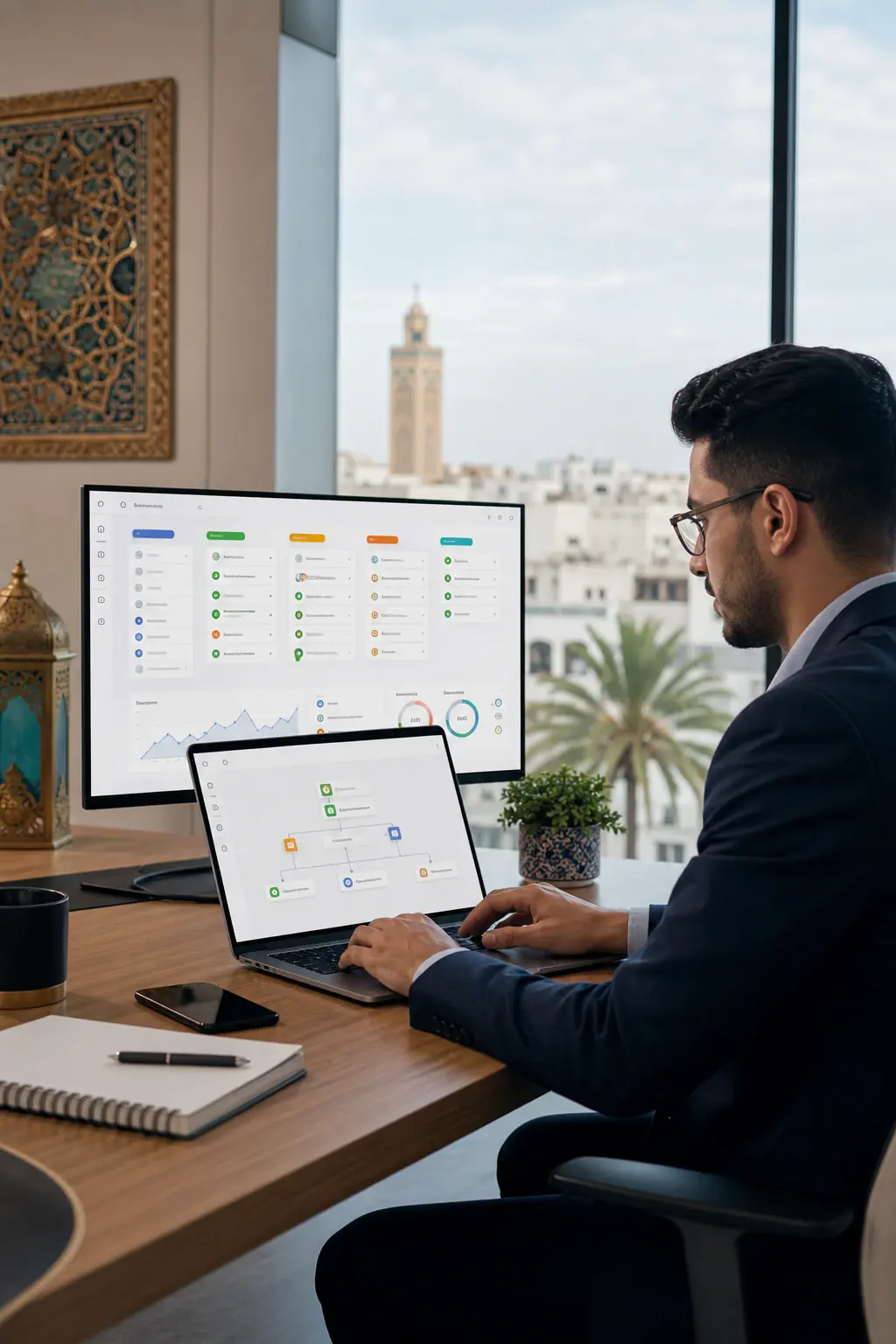
In 2026, a profitable digital strategy connects clear targeting, clean data, useful content, measurable acquisition, SEO/GEO, CRM and automation.
Clarify before investing
The first digital priority in 2026 is not adding another channel. It is clarifying what the business really wants to achieve: awareness, qualified traffic, leads, sales, repeat purchase, appointments or brand perception. Without that frame, media budgets, SEO/GEO, content and automation move in separate directions.
For a brand in Morocco or internationally, this needs to be concrete. An admissions campaign in education does not behave like retail, real estate or institutional communication. Audiences, proof points, decision cycles and conversion criteria are different. Profitable growth starts with a simple reading: who are we targeting, in which city, with which promise, and what signal proves progress?

The 6 priorities to work on
Companies that progress in 2026 build a clearer system. They are not only looking for more impressions or more clicks: they need useful signals, helpful content, shorter journeys and a better ability to decide.
These levels are not a universal promise. They show the most common order of priority we observe: without reliable data, campaigns learn poorly; without clear creative, audiences do not react; without CRM, conversion is often lost after the click.
1. Clean data before scaling
Data is not there to decorate a dashboard. It is there to support decisions. In 2026, brands need to make their sources reliable: GA4, GTM, ad pixels, conversion events, forms, WhatsApp, CRM and field sales. The key is to connect acquisition cost with real quality: serious request, appointment, registration, order or repeat purchase.
Data also needs to stay readable for sales teams. A useful report answers simple questions: which city converts best, which campaign generates qualified leads, which offer creates demand, which creative attracts the right profiles and which follow-up accelerates decisions.
2. Move from content to proof
Producing content is not enough. Content must reassure, explain, compare, demonstrate and help people choose. In education, proof may cover programs, admissions and career outcomes. In real estate, it is location, typology, price, availability and appointments. In retail and grocery, it is offers, proximity, availability and commercial peaks.
Useful content becomes a reusable asset: landing page, ad, short video, SEO/GEO answer, WhatsApp message, FAQ and sales argument. The clearer the proof, the more profitable campaigns become.
3. Manage media more rigorously
Paid media remains central, but it requires stronger discipline. Buying traffic without measuring quality confuses activity with performance. Meta, Google, TikTok, LinkedIn or programmatic campaigns must connect to fast landing pages, reliable conversion events and regular sales feedback.
The real question is no longer only: “how much does the lead cost?” It becomes: “what type of lead costs this amount, in which area, with which potential and conversion probability?” That nuance changes budget decisions.
| Lever | What it should produce | Indicator to follow |
|---|---|---|
| Paid media | Qualified demand, useful traffic, faster creative testing. | Qualified CPL, conversion rate, sales quality. |
| SEO / GEO | Durable visibility on Google and AI engines. | Cited pages, rankings, organic traffic, assisted leads. |
| CRM & WhatsApp | Fast follow-up, qualification and lower friction. | Response rate, appointments, sales, handling time. |
| Creative | Attention, comprehension and proof of value. | Hook rate, useful engagement, conversion by message. |
4. Build SEO/GEO as a commercial asset
SEO captures existing demand. GEO prepares content to be understood, reused and cited by AI engines. Both work together. A useful page must answer quickly, structure arguments, prove expertise and connect the topic to other pages on the site.
For Richmedia, this means building pillar pages, sector pages, in-depth articles, useful FAQs, case studies and logical internal linking. The goal is not only traffic: it is to create a trusted surface around business queries.
5. Connect WhatsApp, CRM and automation
Many companies lose conversion after the click. The prospect sees an ad, visits a page, asks a question, then waits too long. WhatsApp and CRM reduce this gap, but only when scenarios are well designed: source, city, need, maturity, offer and next step.
Automation does not replace humans. It helps respond faster, segment better and transfer the right context to teams. The agency’s role is to define the journeys where automation adds real value without weakening the relationship.
6. Decide faster, with more method
Profitable growth comes from decision cadence. Every week, teams should know what is progressing, what is blocking and what deserves more budget. Decisions should not rely on intuition or one isolated metric.
At Richmedia, we structure this cadence around three levels: operational campaign reading, business reading of result quality, and strategic arbitration. This method makes it easier to invest harder when signals are strong and correct quickly when they are not.

What to remember
In 2026, digital performance does not depend on one miracle channel. It depends on system coherence: strategy, creative, media, SEO/GEO, CRM, WhatsApp, automation and reporting. Winning brands are those that turn digital actions into faster, more measurable and more business-oriented decisions.